
Many people assume that simply living in the UK automatically makes them a UK tax resident. In reality, tax residency is determined by a set of legal rules known as the Statutory Residence Test (SRT).
Whether you have recently moved to the UK, left the country, work overseas, travel frequently for business or earn income from multiple countries, your UK tax residency status can directly affect:
- Which income is taxable in the UK
- Whether foreign income must be declared
- Eligibility for tax reliefs
- Capital Gains Tax obligations
- Inheritance Tax planning
- Your Self Assessment filing requirements
Understanding your residency status is one of the most important parts of effective tax planning. This guide explains the UK Statutory Residence Test in straightforward language so you can better understand how HMRC determines your tax residency.
What Is UK Tax Residency?
UK tax residency determines whether HMRC considers you a UK resident for tax purposes during a tax year. Your residency status influences how much of your worldwide income may fall within the UK tax system.
Being a UK resident does not automatically depend on your nationality, passport or immigration status. Instead, it depends on specific residency rules established under the Statutory Residence Test. Each tax year is assessed separately, meaning your residency status can change from one year to the next depending on your circumstances.
What Is the Statutory Residence Test (SRT)?
The Statutory Residence Test (SRT) is the official method HMRC uses to determine whether an individual is UK resident for tax purposes. The test generally considers:
- The number of days you spend in the UK
- Whether you have a home in the UK
- Your work pattern
- Family connections
- Previous UK residency
- Other personal ties to the UK
The SRT follows three stages, which are considered in order.
Step 1: Automatic Overseas Tests
You may be treated as non-UK resident if you satisfy one of the Automatic Overseas Tests. These tests generally apply to individuals who:
- Spend only a limited number of days in the UK during the tax year
- Work full-time overseas while meeting certain conditions
- Have left the UK and meet the required absence rules
If one of these tests applies, there is usually no need to continue through the remaining stages of the Statutory Residence Test.
Step 2: Automatic UK Tests
If none of the Automatic Overseas Tests apply, HMRC considers whether you meet one of the Automatic UK Tests. You may automatically be considered a UK tax resident if, for example:
- You spend a sufficient number of days in the UK during the tax year.
- Your only home is in the UK for a qualifying period.
- You work full-time in the UK under the relevant conditions.
Meeting an Automatic UK Test generally means you are treated as UK resident for that tax year.
Step 3: The Sufficient Ties Test
If neither the Automatic Overseas nor Automatic UK Tests determine your status, HMRC applies the Sufficient Ties Test. This examines how closely connected you remain to the UK. Common ties include:
-
Family Tie
You may have a family tie if certain close family members are UK residents.
-
Accommodation Tie
Having accessible accommodation available in the UK can create an accommodation tie.
-
Work Tie
Working in the UK for enough qualifying days during the tax year may create a work tie.
-
90-Day Tie
This considers whether you spent significant time in the UK during previous tax years.
-
Country Tie
For individuals who were previously UK resident, spending more days in the UK than in any other single country may also be relevant. The number of UK ties required depends on both:
- The number of days spent in the UK
- Whether you were UK resident in previous tax years.
Why Do the Number of Days Matter?
One of the most important factors in the Statutory Residence Test is the number of days you spend in the UK. HMRC has detailed rules on:
- What counts as a UK day
- Exceptional circumstances
- Transit through the UK
- Temporary visits
- Work-related travel
Keeping accurate travel records throughout the year is particularly important for anyone who travels internationally.
What Is Split Year Treatment?
Sometimes an individual arrives in or leaves the UK during a tax year. In certain circumstances, Split Year Treatment allows the tax year to be divided into:
- A UK resident period
- A non-UK resident period
This can affect which income is taxable in the UK during that year. Split Year Treatment only applies where specific statutory conditions are met and is not automatic.
Why Your Tax Residency Status Matters
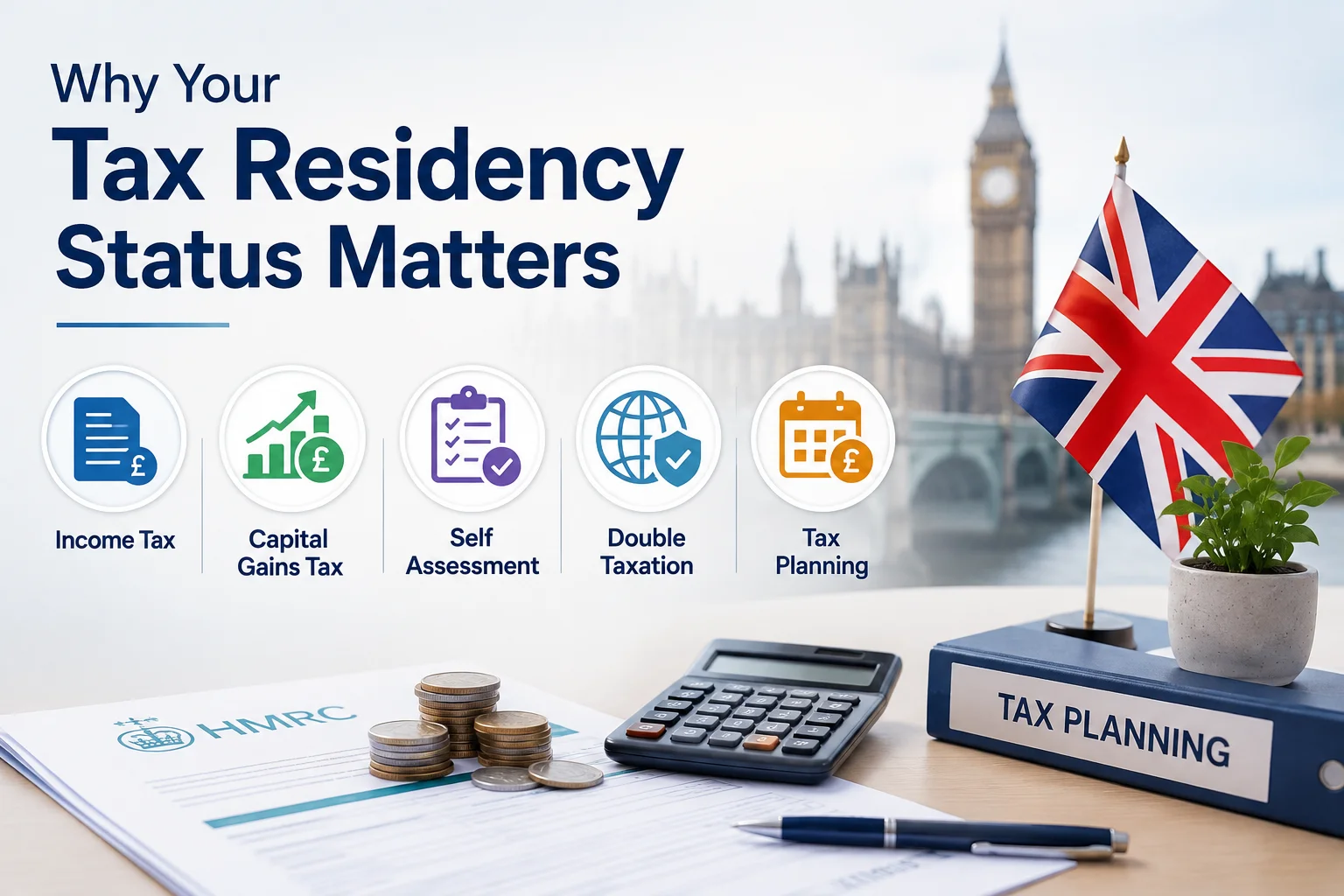
Your residency status can influence several important tax obligations, including:
-
Income Tax
UK residents may need to consider UK tax rules on income arising both within and outside the UK, depending on their circumstances and applicable tax rules.
-
Capital Gains Tax
Residency status can affect how gains on certain asset disposals are taxed.
-
Self Assessment
Many UK residents are required to submit a Self Assessment tax return if they meet HMRC’s filing criteria.
-
Double Taxation
If you have income from more than one country, tax treaties may help prevent the same income from being taxed twice, subject to the relevant treaty provisions.
-
Tax Planning
Knowing your residency status early can help you make informed financial and tax decisions.
Common Situations Where the SRT Becomes Important
The Statutory Residence Test is particularly relevant if you:
- Move to the UK from another country.
- Leave the UK to live or work overseas.
- Frequently travel internationally.
- Work remotely across different countries.
- Own overseas investments or property.
- Receive foreign employment income.
- Have businesses operating in multiple countries.
Each situation requires careful consideration of the residency rules.
Common Mistakes People Make
Many taxpayers incorrectly assume that:
- Living outside the UK automatically makes them non-resident.
- Spending fewer than 183 days in the UK always means they are non-resident.
- Nationality determines tax residency.
- Working overseas alone removes UK tax obligations.
- Split Year Treatment applies automatically.
The Statutory Residence Test is more detailed than these common assumptions and each individual’s circumstances must be considered carefully.
How to Prepare for the Statutory Residence Test
Good record-keeping can make determining your residency status much easier. You should consider maintaining records of:
- UK arrival and departure dates
- Flight and travel records
- Employment details
- Accommodation arrangements
- Days worked in the UK
- Overseas work schedules
Having accurate records can be helpful if HMRC requests evidence of your residency position.
Final Thoughts
Your UK tax residency status is one of the foundations of your UK tax obligations. Although the Statutory Residence Test provides a structured framework, the outcome depends on your individual circumstances, including where you live, work, travel, and maintain personal connections.
Because the rules can be complex, particularly for internationally mobile individuals, it is important to keep accurate records and review your residency position each tax year. Understanding how the Statutory Residence Test works will help you meet your obligations with confidence and make informed tax planning decisions.
While understanding these core principles helps you assess your overall position, navigating the nuances of UK residency often requires expert guidance. If you need tailored tax planning or comprehensive assistance with your UK Self Assessment tax return, SHRM Tax Advisors is here to help. Our experienced team can evaluate your unique circumstances, ensure full compliance with HMRC, and help optimize your tax position.