Corporation Tax work rarely arrives at a convenient time. One company is ready for its return. Another is still waiting for final accounts. A third has unexplained balances that need reviewing. At the same time, your team may already be managing payroll, VAT, Self Assessment and year-end accounts for other clients.
When that pattern repeats across dozens or hundreds of clients, the problem is often not a lack of technical knowledge. It is capacity. Corporation Tax outsourcing allows a UK accounting practice to assign clearly defined preparation work to an external accounting or tax team while retaining appropriate oversight, technical review and control of the client relationship.
Used properly, outsourcing can support an existing team. Used without a clear workflow, it can simply create another layer of work to manage. This guide explains where Corporation Tax outsourcing can fit into a UK accounting practice, which activities may be suitable for external support and what firms should check before sending client work outside their internal team.
What Is Corporation Tax Outsourcing?
Corporation Tax outsourcing means engaging an external provider to complete agreed parts of the Corporation Tax compliance process. The exact scope varies between providers and practices. Depending on the provider’s competence and the agreed engagement, outsourced support might cover:
- Preparing Corporation Tax working papers
- Reconciling figures to the statutory accounts
- Preparing draft tax computations
- Preparing information for a CT600
- Preparing draft Company Tax Returns for review
- Identifying missing information
- Raising queries for the UK practice
- Organising supporting schedules
- Preparing files for internal technical review
The key word is draft. An accounting firm should establish from the beginning who prepares the work, who reviews technical treatments, who approves the final return and who interacts with HMRC.
HMRC’s Standard for Agents applies to individuals and businesses providing tax services and expects tax agents to maintain appropriate standards when dealing with clients’ tax affairs. Outsourcing changes where part of the work is performed. It does not automatically remove the professional responsibilities of the firm acting for the client.
Why Corporation Tax Creates Capacity Pressure
Corporation Tax work depends heavily on other parts of the accounting process. Before a return can usually be finalised, the practice may need:
- Completed bookkeeping
- Final accounts
- Reconciled balances
- Details of relevant adjustments
- Information about company transactions
- Answers to client queries
- Supporting records for positions taken in the computation
That makes Corporation Tax different from a task that can simply be processed independently. There is also an important difference between paying Corporation Tax and filing the Company Tax Return.
For most companies within the normal payment rules, Corporation Tax is usually payable nine months and one day after the end of the accounting period, while the Company Tax Return is normally due 12 months after the end of that accounting period. Different payment rules apply to companies within the large and very-large-company instalment regimes.
For an accounting practice managing many company clients with different year ends, those rolling obligations can create recurring workload peaks rather than one single annual deadline.
What Corporation Tax Work Can Be Outsourced?
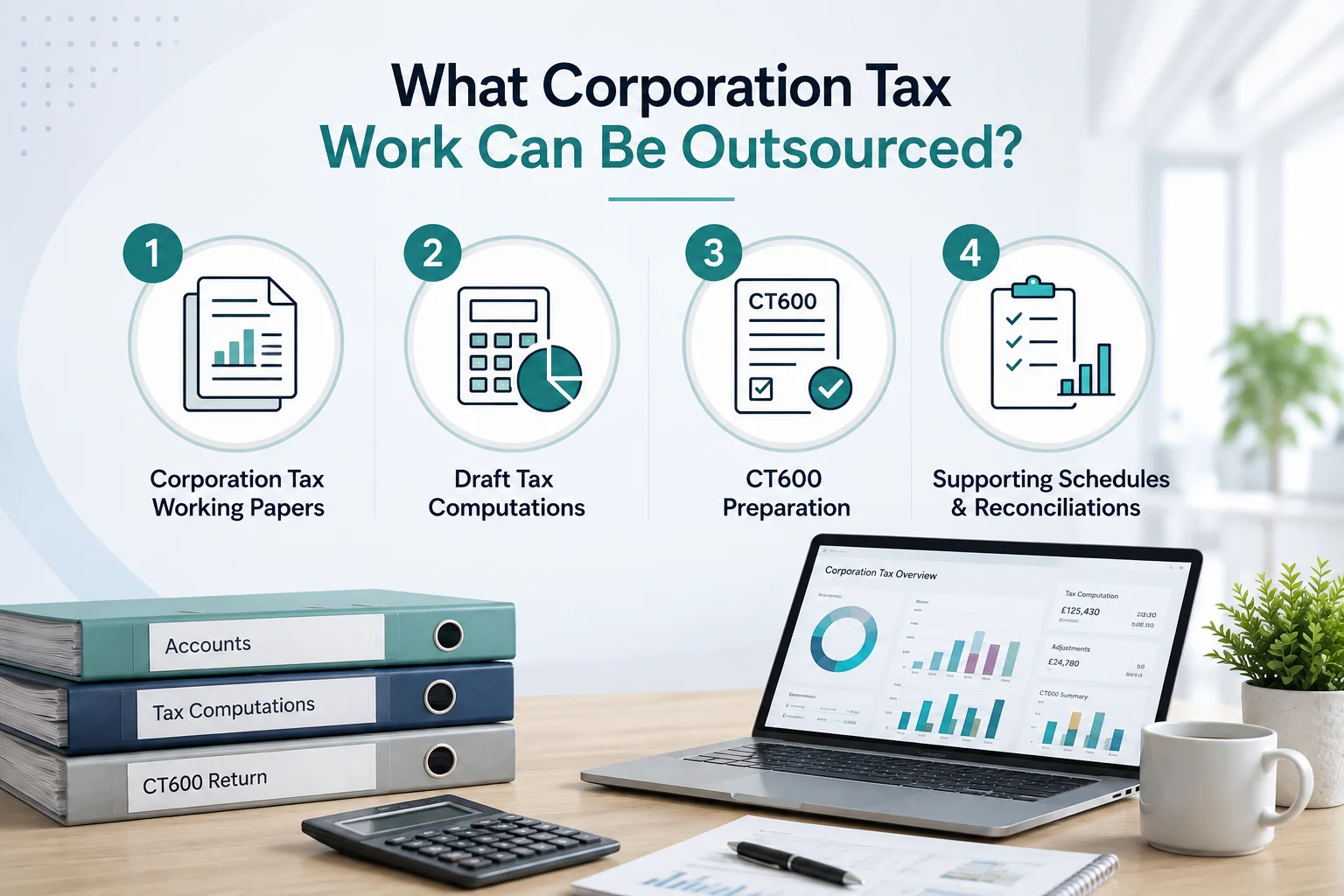
There is no rule saying an entire Corporation Tax engagement must move to an external provider. For many firms, a better model is to outsource repeatable preparation work and retain higher-judgement work internally.
1. Corporation Tax Working Papers
An external team can potentially prepare structured working papers from:
- Final accounts
- Trial balances
- Prior-year files
- Client information
- Internal practice instructions
The purpose is not merely to populate figures. Good working papers should allow the UK reviewer to understand where amounts came from, what adjustments were made and which issues remain unresolved.
2. Draft Tax Computations
Where the provider has suitable competence, it may prepare a draft Corporation Tax computation based on the accounts and information supplied. Items requiring judgement should be clearly identified rather than silently resolved. That distinction matters because some company tax positions can involve facts or technical analysis that fall outside a routine preparation process.
3. CT600 Preparation
HMRC’s Company Tax Return process includes the CT600 together with the relevant Corporation Tax computation and company accounts. From 1 April 2026, companies generally need commercial software to file their annual accounts and Company Tax Returns with HMRC after the previous joint online filing service closed.
An outsourced team may therefore prepare return information within the agreed software workflow, ready for the practice’s review. The firm should establish separately who is authorised to make the final submission.
4. Supporting Schedules and Reconciliations
Corporation Tax files may involve additional schedules or reconciliations before the return can be reviewed efficiently. An outsourced team can potentially assist with agreed preparation work, provided there is a clear process for escalating anything outside the standard workflow. The objective should be to return a file that is review-ready, not simply a partially completed CT600 accompanied by unanswered questions.
What Should Remain With the UK Accounting Practice?
Outsourcing works best when both teams understand exactly where their responsibility ends. Depending on the engagement, the UK practice may retain responsibility for areas such as:
- Client acceptance and engagement
- Technical tax decisions
- Reviewing unusual transactions
- Judgements around tax treatments
- Final review and approval
- Client communication
- HMRC correspondence
- Anti-money-laundering responsibilities
- Resolving complex tax questions
That does not mean an outsourced provider cannot contain experienced tax professionals. It means the operating model should make accountability clear. A poor outsourcing arrangement sounds like: “Send us the company and we will deal with everything.” A controlled arrangement sounds more like:
“You prepare these defined schedules, computation and draft return. Our team reviews these specified areas, resolves technical matters and approves the final submission.”
Corporation Tax Outsourcing Is Not the Same as Giving Up Client Control
Some accounting firms hesitate to outsource because they worry that an external team will interfere with their client relationships. It does not have to work that way. A common model is:
Client → UK accounting practice → outsourced preparation team → UK reviewer → client
The outsourcing provider operates behind the practice rather than replacing it. The UK firm continues to manage:
- Client communication
- Advice
- Expectations
- Review
- Approval
- Relationship management
This is particularly useful where the main problem is processing capacity rather than a lack of senior tax expertise.
A Practical Outsourced Corporation Tax Workflow
A well-defined process can look like this.
Step 1: Select Suitable Files
Not every company should necessarily enter the outsourced workflow. A practice might begin with more standard Corporation Tax engagements and retain highly complex cases internally. The selection criteria should reflect:
- Client risk
- Technical complexity
- Provider competence
- Quality-control requirements
- Internal review capacity
Step 2: Supply a Complete File
The external preparer should receive a consistent information pack. Depending on the engagement, this could include:
- Final or draft statutory accounts
- Trial balance
- Previous-year Corporation Tax return
- Previous working papers
- Current-year supporting information
- Practice instructions
- Known client issues
- Relevant deadlines
Sending incomplete files and answering queries one document at a time removes much of the efficiency outsourcing is supposed to create.
Step 3: Prepare the Corporation Tax File
The outsourced team performs the agreed work. That might include:
- Working papers
- Reconciliations
- Draft computation
- Draft CT600
- Supporting schedules
- Query list
Anything requiring technical judgement outside the agreed scope should be escalated rather than assumed.
Step 4: Internal Review
The completed file returns to the UK practice. The reviewer should be able to trace material figures back to the accounts and working papers, understand the adjustments and see which questions were raised. This is where the quality of outsourcing becomes obvious. If your reviewer must reconstruct the return from the beginning, the provider has not genuinely created capacity.
Step 5: Resolve Client Queries
Questions identified during preparation or review can then be taken back to the client through the accounting practice. This keeps client communication consistent and avoids clients receiving disconnected questions from multiple teams.
Step 6: Approve and File
Once review and client approval are complete, the return can move through the practice’s agreed filing process. HMRC provides a Corporation Tax for Agents online service for authorised agents managing clients’ Corporation Tax affairs, and Company Tax Returns must generally be submitted online with the required supporting documentation.
2026 HMRC Agent Registration Changes Also Matter
Accounting practices should pay particular attention to who actually interacts with HMRC. From 18 May 2026, HMRC began rolling out mandatory registration requirements for paid tax advisers who interact with HMRC on behalf of clients. HMRC’s registration rollout runs in stages, and firms should check which requirements and dates apply to them.
HMRC’s current guidance states that if you are paid to interact with HMRC about somebody else’s tax affairs, you must register as a tax adviser where the rules apply. For an outsourced Corporation Tax arrangement, this makes it important to document:
- Who prepares the return
- Who interacts with HMRC
- Who is authorised by the client
- Who makes the submission
- Which tax-agent registrations apply
Firms should check the current HMRC requirements for their specific operating model rather than assuming that outsourcing preparation changes their registration obligations.
Data Protection Cannot Be an Afterthought
Corporation Tax files can contain sensitive business and personal data. An external provider may potentially receive access to:
- Company financial information
- Director details
- Payroll information
- Bank records
- Tax identifiers
- Shareholder information
- Supporting accounting documents
Where an outsourcing provider processes personal data on behalf of the practice, the parties need to establish their roles under UK data-protection law. The ICO states that whenever a controller uses a processor, there must be a written contract or other legal act in place, and UK GDPR specifies matters that must be covered in that contract. The practice should therefore establish:
- Who can access client data
- Where the data is processed
- Which systems are used
- Whether sub-processors are involved
- How access is controlled
- How long information is retained
- What happens when the engagement ends
- How security incidents are handled
If information is made accessible outside the UK, the international-transfer rules may also need to be considered. The ICO provides specific guidance on determining whether a restricted transfer exists and what safeguards may be required.
How to Decide Whether Corporation Tax Outsourcing Will Actually Create Capacity
Not every outsourced file creates useful capacity. The real test is what happens when the work comes back. Ask:
How much review time is required?
If a normal internal file takes three hours to prepare and one hour to review, but an outsourced file takes two and a half hours to correct, very little capacity has been created.
How many queries are raised?
Queries are normal. Repeated basic questions caused by poor handovers or lack of UK tax familiarity are a warning sign.
Is the work consistent?
A practice should not receive excellent files from one preparer and substantially different work from another. Consistency matters when outsourcing is being used at scale.
Are deadlines reliable?
Turnaround expectations should be documented and measured. A provider that regularly returns files late simply moves deadline pressure from one team to another.
Can the provider recognise when to escalate?
This is one of the most important measures. A good outsourced preparer should know when a matter is outside the routine process and needs technical input from the UK team.
What Should You Check Before Choosing a Corporation Tax Outsourcing Provider?
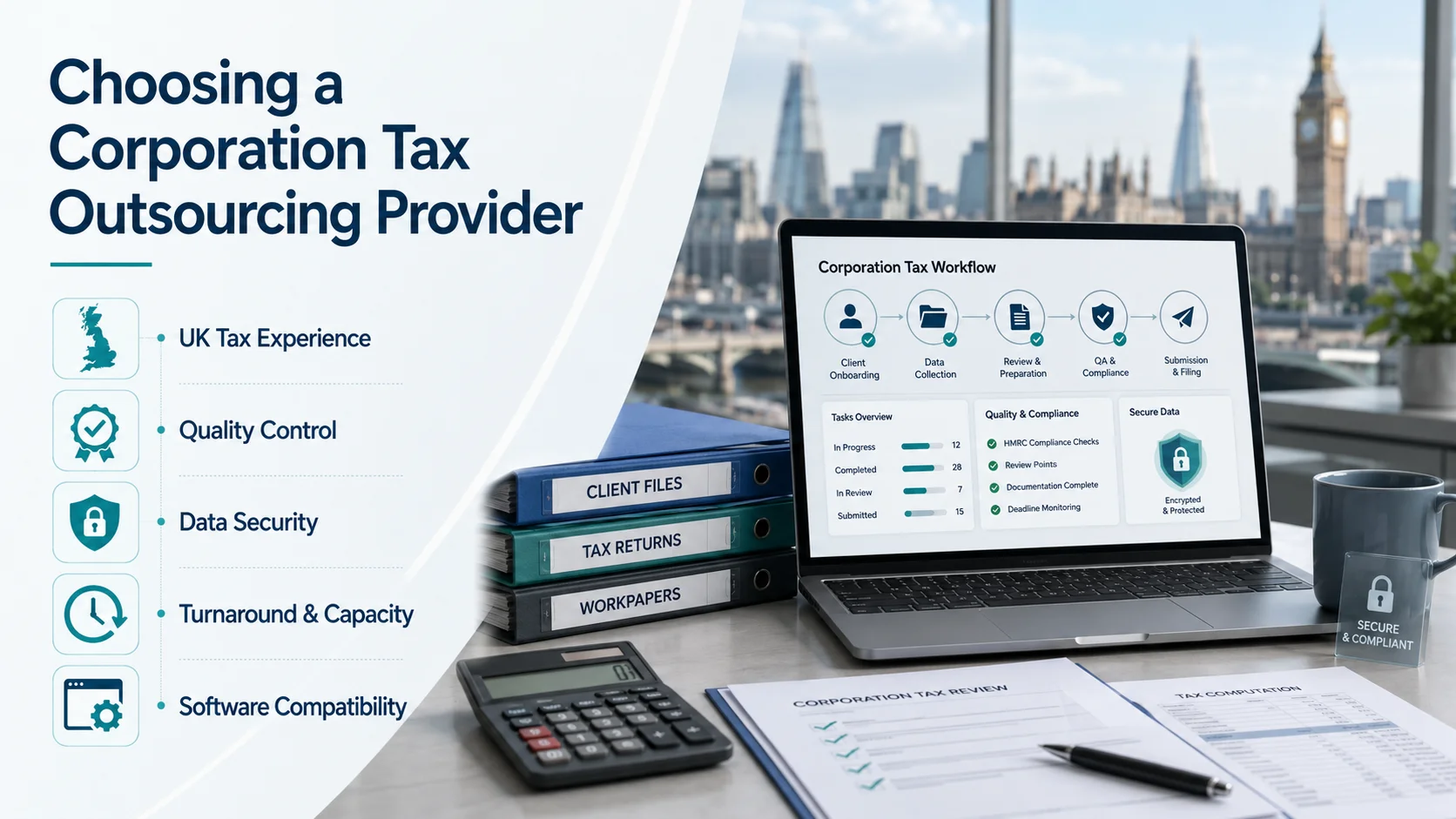
Before moving client files, examine more than price.
UK Corporation Tax experience
Ask what Corporation Tax work the team actually performs. Confirm experience with:
- UK statutory accounts
- Corporation Tax computations
- CT600 preparation
- Relevant tax software
- Practice working papers
- UK accounting-firm workflows
Quality control
Understand:
- Who prepares the file
- Who reviews it before return
- How errors are recorded
- How recurring errors are addressed
- How technical issues are escalated
Data security
Review:
- Data-processing agreements
- Access controls
- Data location
- Sub-processors
- Overseas access
- Retention arrangements
- Incident procedures
Turnaround and capacity
Ask whether stated turnaround times still apply during peak periods. If the reason for outsourcing is capacity, the provider itself must have enough capacity when your firm needs it most.
Software compatibility
Since HMRC’s old joint online filing service closed on 31 March 2026 and commercial software is now required for Company Tax Returns, software compatibility has become even more important to the workflow. The provider should be able to work effectively within the systems your practice uses or within an agreed secure alternative.
How SHRM Tax Advisors Can Support Corporation Tax Work
SHRM Tax Advisors’ published Outsourced Accounting Services include statutory accounts preparation and Corporation Tax returns (CT600) alongside bookkeeping, VAT/MTD support, management accounts, payroll integration and other accounting support.
SHRM also has a dedicated Corporation Tax service covering CT600 preparation and filing for UK limited companies and other relevant businesses. For an accounting practice exploring Corporation Tax outsourcing, the sensible starting point is to define the required scope clearly:
- How many company files require support?
- What stage will each file reach before outsourcing?
- Is support needed for accounts preparation, Corporation Tax preparation or both?
- What software is currently used?
- What turnaround times are required?
- Which work remains with the internal tax team?
- Who will communicate with the client and HMRC?
Once those points are clear, it becomes much easier to judge whether external support will genuinely increase capacity.
Final Thoughts
Corporation Tax outsourcing can help UK accounting firms deal with recurring compliance workloads without automatically turning every period of high demand into a recruitment problem. But useful outsourcing is not simply about sending CT600 work elsewhere. It requires a controlled process covering:
- File preparation
- Clearly defined responsibilities
- Appropriate technical competence
- Internal review
- Query management
- HMRC responsibilities
- Client confidentiality
- Data protection
- Reliable turnaround times
The goal should be simple: routine preparation work is completed efficiently, while the accounting practice retains the professional judgement, review and client control that matter. When that balance is achieved, outsourced Corporation Tax support can become an extension of the firm’s delivery capacity rather than another workload for the internal team to manage.
If your accounting practice needs additional capacity for Corporation Tax, statutory accounts or related outsourced accounting work, contact SHRM Tax Advisors to discuss the scope and workflow required.
This article provides general information for UK accounting practices and does not constitute legal, regulatory or personalised tax advice. Firms should check the requirements applying to their own professional body, HMRC registration, AML supervision and data-processing arrangements. Information reviewed against current HMRC, GOV.UK and ICO guidance in August 2026.