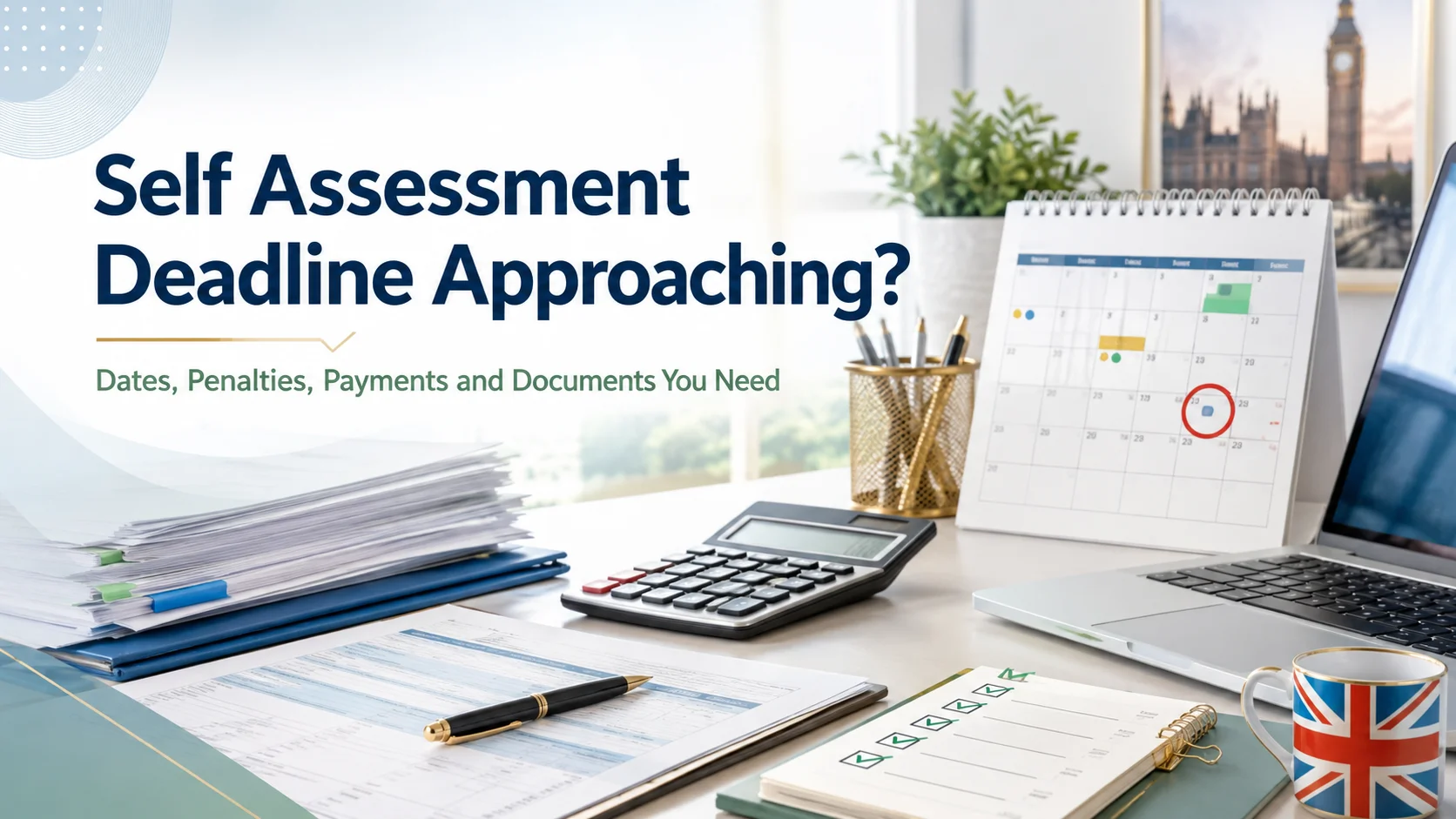
The Self Assessment process does not end when you complete your tax return. You must also submit it by the correct deadline, understand what you owe and ensure that your payment reaches HMRC on time.
For the 2025/26 tax year, most people filing online must submit their return and pay the tax due by 31 January 2027. A paper return normally has an earlier deadline of 31 October 2026. Missing either the filing or payment deadline can result in separate penalties and interest.
This guide explains the important dates, how late-filing penalties work, how to pay your Self Assessment tax bill, what payments on account mean and which records you should prepare before starting your return.
Self Assessment Deadlines for the 2025/26 Tax Year
The 2025/26 tax year ran from 6 April 2025 to 5 April 2026. The principal registration, filing and payment dates are:
Requirement | Deadline |
Register or reactivate Self Assessment when required | 5 October 2026 |
Submit a paper tax return | 31 October 2026 |
Submit online to request eligible collection through PAYE | 30 December 2026 |
Submit an online tax return | 31 January 2027 |
Pay the balancing tax due | 31 January 2027 |
Pay the first payment on account, where required | 31 January 2027 |
Pay the second payment on account, where required | 31 July 2027 |
HMRC must receive a paper return by 11:59pm on 31 October 2026. Online returns must normally be submitted by 11:59pm on 31 January 2027, and the tax due must also be paid by that January deadline.
First-time filers should normally register by 5 October following the end of the relevant tax year. If you were previously registered but did not submit a return for the preceding year, you may need to reactivate your existing Self Assessment account rather than register again.
Should You Wait Until January to File?You can submit your tax return any time after the end of the tax year. Filing early does not bring the normal payment deadline forward, but it allows you to see the amount due sooner and gives you more time to budget or address missing information. Waiting until the final week can create unnecessary difficulties if:
- You cannot access your HMRC account
- Your Unique Taxpayer Reference is missing
- Employment or pension documents are incomplete
- Your bookkeeping records do not reconcile
- You discover unexpected property, foreign or investment income
- Your tax bill is higher than anticipated
Completing the return early gives you time to review the calculation instead of rushing simply to meet the tax-return filing deadline.
What Happens If You Miss the Self Assessment Deadline?
A late Self Assessment return can lead to penalties that increase the longer it remains outstanding. HMRC’s current late-filing penalty structure includes:
- An initial £100 penalty
- After three months, daily penalties of £10 per day, up to £900
- After six months, a further penalty of 5% of the tax due or £300, whichever is greater
- After twelve months, another penalty of 5% of the tax due or £300, whichever is greater
Filing late and paying late are treated separately. Submitting the return does not remove the need to pay, and paying an estimated amount does not remove the requirement to file the return.
Late-Payment Penalties and Interest
When Self Assessment tax remains unpaid, HMRC can charge penalties equal to 5% of the unpaid tax at:
- 30 days
- Six months
- Twelve months
Interest is also charged on outstanding tax. This means that someone who files and pays late may face:
- Late-filing penalties
- Late-payment penalties
- Interest on the unpaid balance
The sensible response to a missed deadline is to file and pay as soon as possible rather than waiting for the next penalty stage.
Can You Appeal a Self Assessment Penalty?
You can appeal if you disagree with a penalty and believe you had a reasonable excuse for filing or paying late. HMRC will normally require information such as:
- The date of the penalty
- The date you submitted the return
- The date you paid the tax
- Details and evidence of the reason for the delay
An appeal does not automatically cancel the penalty. HMRC reviews the circumstances before deciding whether it should remain payable.
You should not rely on an appeal as a substitute for dealing with an overdue return. Submit the return and address the outstanding payment while the appeal is being considered.
How to Pay Your Self Assessment Tax Bill
The main Self Assessment payment deadline is normally:
- 31 January for the balancing payment and first payment on account
- 31 July for the second payment on account
HMRC provides several payment methods, including:
- Payment through an online bank account
- The HMRC app
- Faster Payments through online or telephone banking
- CHAPS
- Bacs
- Direct Debit
- Personal debit card
- Corporate debit or credit card
- Payment at a bank or building society with an HMRC paying-in slip
Different methods require different processing times. Some are normally completed on the same or next day, while Bacs and Direct Debit payments may need several working days. You should therefore check the applicable processing time rather than initiating the payment on the deadline without confirming when HMRC will receive it.
Can You Pay Through Your PAYE Tax Code?Some employees and pensioners may be able to have a relatively small Self Assessment bill collected through their PAYE tax code. HMRC states that all of the following must apply:
- The amount owed is less than £3,000
- You already pay tax through PAYE
- You submitted a paper return by 31 October or an online return by 30 December
Other restrictions can apply, including whether there is enough PAYE income for HMRC to collect the amount. You should not assume that payment through PAYE will be available until the eligibility conditions have been checked.
What Are Payments on Account?
Payments on account are advance payments towards your next Self Assessment bill. They can include Income Tax and Class 4 National Insurance where applicable. They are normally divided into two instalments:
- The first payment is due on 31 January
- The second payment is due on 31 July
Each payment is normally half of the relevant tax owed for the previous year.
Who Normally Makes Payments on Account?Payments on account are generally required unless:
- The relevant tax owed for the previous year was less than £1,000, or
- More than 80% of the previous year’s tax was collected outside Self Assessment, such as through PAYE
Your HMRC online account or Self Assessment statement should show whether payments on account apply and how much is due.
Why Can the First January Bill Feel So High?First-time filers are sometimes surprised because their January payment can include:
- The full tax due for the completed tax year
- The first payment on account towards the following tax year
For example, where the relevant tax bill is £3,000 and payments on account apply, the January amount may include the £3,000 bill plus a first payment on account of £1,500. A second payment of £1,500 would then be due in July. This is not double taxation. The two advance payments are credited towards the next year’s bill.
What Is a Balancing Payment?Your final tax position may differ from the amount covered by payments on account. If the two advance payments were less than the final liability, the remaining amount is called a balancing payment. It is normally payable by 31 January following the end of the relevant tax year. If the payments on account were higher than the final liability, the account may show that you have overpaid.
Can Payments on Account Be Reduced?You can ask HMRC to reduce payments on account when you reasonably expect the following year’s tax liability to be lower. This may be relevant when:
- Business profits are expected to fall
- You have stopped self-employment
- Rental income has reduced
- More income will be taxed through PAYE
However, if you reduce the payments too far and the final bill is higher than expected, HMRC can charge interest on the difference. The reduction should therefore be based on a realistic calculation rather than a temporary cash-flow preference.
Can You Pay Weekly or Monthly?
If your previous Self Assessment payments are up to date, you may be able to use HMRC’s Budget Payment Plan to make weekly or monthly Direct Debit payments towards your next bill.
These payments reduce the amount remaining at the deadline. If the plan does not cover the full liability, the outstanding difference must still be paid on time. A Budget Payment Plan is different from a Time to Pay arrangement:
- A Budget Payment Plan helps you save towards a future bill.
- A Time to Pay arrangement may be available when you cannot pay an existing bill in full.
HMRC assesses whether a Time to Pay arrangement is affordable before agreeing it.
What Documents Do You Need for a Self Assessment Tax Return?
The exact records depend on your income and circumstances. A practical Self Assessment documents checklist should begin with the following categories.
Personal and HMRC DetailsPrepare:
- National Insurance number
- Unique Taxpayer Reference
- HMRC online-account login details
- Previous Self Assessment statements, where relevant
- Details of payments on account already made
Your UTR can normally be found on earlier returns, HMRC statements, payment reminders, your online account or the HMRC app.
Employment IncomeWhere you were employed during the tax year, you may need:
- P60
- P45 if you left or changed employment
- P11D for taxable benefits and expenses
- Details of tax already deducted
- Information about employment expenses being claimed
HMRC specifically identifies P60, P45 and P11D information as records that may be required when completing the return.
Self-Employment RecordsSole traders should organise:
- Sales invoices
- Records of all business income
- Business-expense receipts
- Bank statements
- Purchase invoices
- Mileage or business-travel records where relevant
- VAT records if VAT-registered
- PAYE records if employing staff
HMRC requires self-employed taxpayers to maintain records of sales, income, business expenses and other applicable business information. The evidence can include receipts, statements, invoices, till rolls and bank slips.
Property-Income RecordsLandlords may need:
- Rental-income statements
- Tenancy or letting-agent statements
- Property-expense invoices
- Repair and maintenance receipts
- Insurance records
- Mortgage-interest information where relevant
- Details of jointly owned income
- Records relating to property disposals
Not every property expense is automatically deductible, so records should be categorised before figures are entered on the return.
Savings, Investments and DividendsPrepare records showing:
- Bank and building-society interest
- Dividend income
- Investment-platform statements
- Income from trusts or estates where applicable
- Tax already deducted
Pensions and Tax ReliefsRelevant records may include:
- Pension-income statements
- Personal pension-contribution records
- Gift Aid donation details
- Evidence supporting other eligible tax-relief claims
HMRC’s current preparation guidance specifically includes pension statements, pension contributions and Gift Aid information.
Capital Gains and Overseas IncomeWhere relevant, collect:
- Purchase and sale documents for disposed assets
- Records of associated acquisition or disposal costs
- Details of overseas income
- Foreign tax deducted
- Overseas bank, employment, pension or property statements
HMRC lists capital-gains records and overseas-income records among the information that may be needed for a Self Assessment return. International income and residence questions can require separate analysis. They should not be resolved solely by converting foreign amounts into sterling and adding them to the return.
Do You Send Every Document to HMRC?
You do not normally submit all supporting records with the tax return. However, you must keep sufficient evidence to prepare the return accurately and produce it if HMRC checks the figures. Records should be accurate, complete and readable. They may be kept on paper, digitally or through suitable accounting software.
How Long Should You Keep Self Assessment Records?
For people who are not self-employed, HMRC states that records for an on-time return should normally be retained for at least 22 months after the end of the relevant tax year. If the return was submitted late, records should normally be retained for at least 15 months after submission.
Self-employed taxpayers must generally keep business records for at least five years after the 31 January submission deadline for the relevant tax year. Longer retention may be appropriate where a return is under enquiry or records relate to an unresolved tax matter.
A Practical Checklist Before You Submit and Pay
Before completing the process, confirm that you have:
- Checked the correct Self Assessment deadline
- Included every relevant source of income
- Reviewed expenses and reliefs
- Reconciled figures with supporting records
- Checked payments on account already made
- Read the final tax calculation
- Confirmed the payment method and processing time
- Saved the submission confirmation
- Retained a copy of the return
- Checked that HMRC received the payment
A return can be submitted successfully while still containing an omission or incorrect tax treatment. The final review should focus on accuracy, not simply whether every field has been completed.
How SHRM Tax Advisors Can Support You
Self Assessment becomes more difficult when the return includes business income, rental property, several income sources, capital gains, foreign income or payments on account.
SHRM Tax Advisors’ Personal Tax Planning service can support taxpayers who need professional help understanding their filing position, organising relevant information and preparing for the payment due.
Where a missed return, incomplete disclosure or HMRC enquiry has already created a more serious issue, the firm’s HMRC Tax Investigation Support service may also be relevant.
Final Thoughts
The main online Self Assessment deadline for the 2025/26 tax year is 31 January 2027. The tax due must normally be paid by the same date, and a second payment on account may be required by 31 July 2027.
The most effective approach is to prepare the documents early, understand the calculation before submitting and allow enough time for the chosen payment method. Contact SHRM Tax Advisors for professional support with Self Assessment, Personal Tax Planning and related HMRC matters.
This article provides general information and does not constitute personalised tax advice. Tax treatment depends on individual circumstances. Information was checked against current HMRC and GOV.UK guidance on 6 August 2026.