

Personal tax work can place unusual pressure on an accounting practice. For much of the year, the workload may be manageable. Then Self Assessment files begin arriving together. Some clients provide complete records, others send information in stages, queries remain unanswered and experienced staff can end up spending significant time organising routine files instead of reviewing complex cases or speaking with clients.
Personal tax outsourcing gives UK accounting practices another way to structure that workload. Selected tax-preparation activities can be assigned to an external provider while the practice retains clearly defined responsibility for review, client communication and other parts of the engagement.
Professional guidance recognises tax preparation as a type of work that accountancy practices may outsource. However, outsourcing does not remove the need for proper supervision, confidentiality, data protection, anti-money-laundering controls or compliance with the standards applying to tax agents.
So the question is not simply, “Can we outsource our personal tax work?” A better question is: “Which parts can we outsource while keeping the quality and control our clients expect?”
What Is Personal Tax Outsourcing?
Personal tax outsourcing means using an external accounting or tax team to perform agreed elements of personal tax compliance work that would otherwise be completed internally.
The arrangement does not have to involve transferring an entire client engagement. For example, depending on the provider’s competence and agreed scope, an accounting practice might use an outsourced team to:
- Organise client records
- Prepare tax-return working papers
- Process employment and pension information
- Prepare self-employment schedules
- Prepare property-income schedules
- Prepare investment and dividend schedules
- Prepare draft Self Assessment returns
- Prepare draft tax calculations
- Identify missing client information
- Refer technical issues back to the UK practice
The accounting practice may then review the work, resolve technical matters, communicate with the client and approve the final return. ICAEW’s guidance on subcontracting recognises different models, including one where the firm retains responsibility for the client while a subcontractor performs work that is passed back through the firm. It stresses that the responsibilities of both parties should be clear.
Why Do Accounting Practices Outsource Personal Tax Work?
The strongest case for outsourcing is usually capacity management, not simply moving work to somebody else. Personal tax is particularly suited to a structured workflow because many files involve repeatable preparation stages before professional review. Consider what happens during a busy filing period. A tax manager may need to:
- Review previous returns
- Check client documents
- Identify missing information
- Prepare computations
- Resolve queries
- Review junior work
- Contact clients
- Obtain approval
- Manage filing
If senior staff spend too much of that time on routine preparation, there is less capacity available for work that genuinely needs their experience. A well-designed outsourcing arrangement attempts to separate preparation work from technical judgement and review. That does not mean every tax return should be outsourced. Complex or high-risk cases may be more suitable for direct handling by experienced internal staff.
What Personal Tax Work Can Be Outsourced?
The exact scope should always be agreed with the provider. There is no universal personal-tax outsourcing package. However, several parts of the process can potentially be structured for external preparation.
Self Assessment Return Preparation
Self Assessment is one of the most obvious areas for personal tax outsourcing. An outsourced preparer might receive an agreed client file containing:
- Previous-year return
- Current-year information
- Employment documents
- Pension information
- Property records
- Sole-trader accounts
- Investment statements
- Tax already paid
- Relevant notes from the practice
The preparer can then produce working papers and a draft return for internal review. HMRC’s Standard for Agents applies broadly to professional tax agents, including accountants, bookkeepers, third-party agents and agents who file tax returns or related documents.
It expects agents to meet HMRC’s standards when dealing professionally with taxpayers’ tax affairs. For that reason, the review stage should never become an afterthought simply because the preparation was completed externally.
Sole-Trader Tax Work
Personal tax files can include self-employment income as well as employment, investments or other sources. Where the accounting records are complete, an outsourced team may potentially prepare:
- Trading-income schedules
- Expense schedules
- Tax-return working papers
- Draft self-employment supplementary information
- Queries for missing or unclear transactions
The internal practice can then consider matters requiring judgement, such as unusual expenses, accounting adjustments, relief claims or discrepancies between current and prior years.
Landlord and Property-Income Work
Property clients can generate substantial preparation work because records may include:
- Rental statements
- Letting-agent statements
- Repairs and maintenance
- Finance information
- Joint ownership
- Multiple properties
An outsourced preparer may organise and summarise the information within a defined procedure, while technical questions are escalated to the practice. This division can be useful because data processing and tax judgement are not the same activity.
Employment, Pension and Investment Income
Routine personal tax files may contain information from several sources. An outsourced preparation process can be structured to capture figures from supporting documents and reconcile them into working papers before review. The important requirement is traceability: the reviewer should be able to see where a figure came from rather than receiving only a completed return with no supporting trail.
What Should the UK Accounting Practice Retain?
A common mistake is to think about outsourcing solely in terms of the tasks being transferred. The practice should also define what it is not transferring. Depending on the firm’s operating model and professional obligations, this may include:
- Client acceptance
- Engagement terms
- Client relationship management
- Risk assessment
- Technical tax decisions
- Review of unusual items
- Final approval
- Advice given to clients
- HMRC interaction
- AML responsibilities
- Complaints and corrections
ICAEW’s subcontracting guidance specifically says firms should be clear about their respective responsibilities and consider client confidentiality, confidential data, conflicts of interest and the technical requirements of the outsourced work.
The outsourcing provider should therefore operate inside a defined process rather than effectively deciding where its responsibilities begin and end on each individual file.
A Practical Personal Tax Outsourcing Workflow
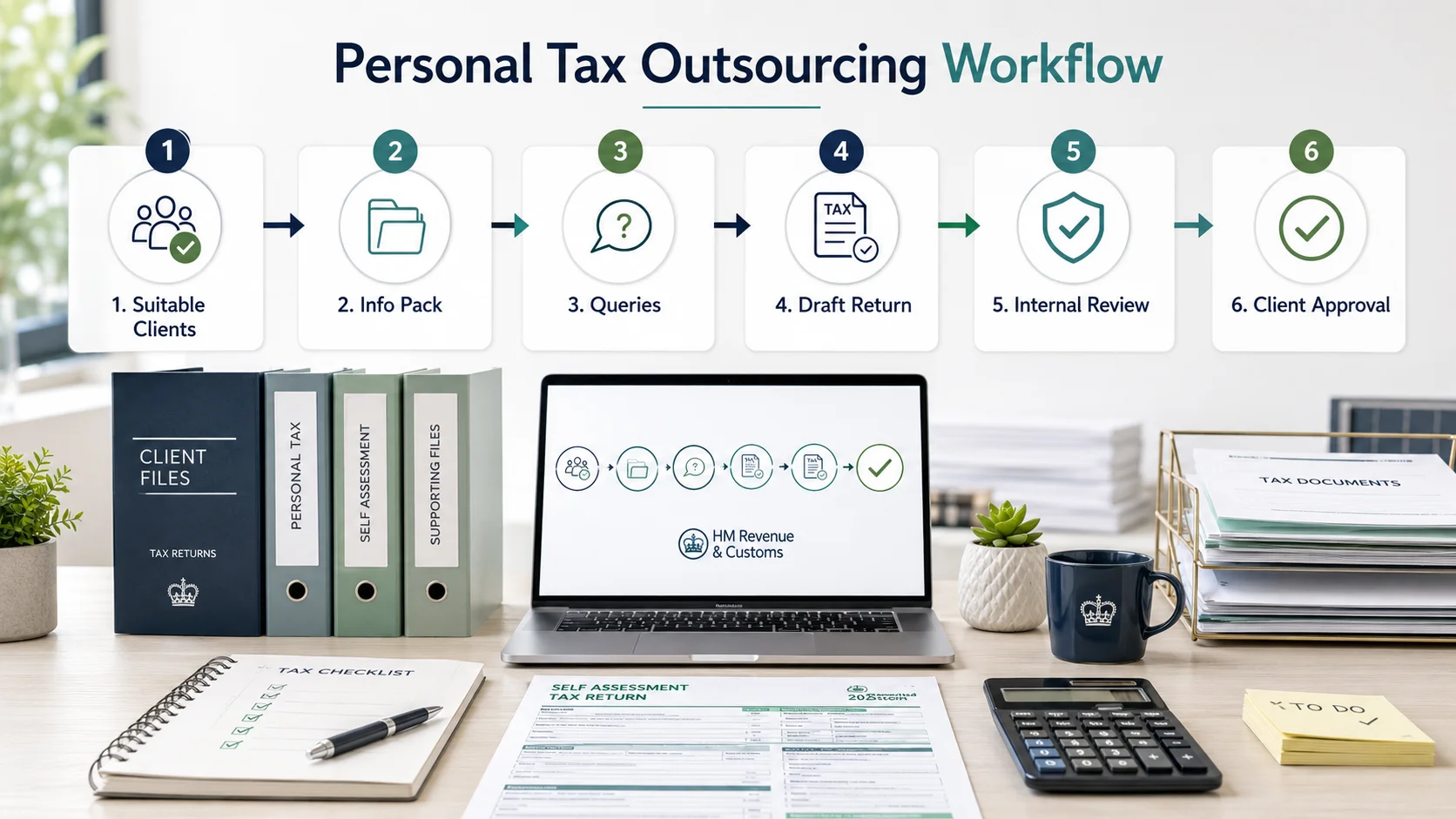
A workable process might look like this.
Step 1: Decide Which Clients Are Suitable
Do not begin by sending every personal tax client to the outsourced team. Start by defining the types of files suitable for the workflow. For example, your practice may decide that straightforward Self Assessment preparation can enter the outsourced process while complex investigations, unusual international matters or higher-risk engagements remain with specialists internally. The dividing line should reflect your practice’s resources, provider competence and risk assessment.
Step 2: Standardise the Information Pack
An outsourced preparer should not have to guess what information is supposed to be present. A standard personal-tax file might include:
- Previous return
- Previous working papers
- Current-year client records
- Tax documents
- Internal notes
- A preparation checklist
- Any known outstanding information
Consistent inputs make consistent output more achievable.
Step 3: Define the Query Process
Not every file will arrive complete. Set clear rules for what happens when:
- A document is missing
- A figure does not agree
- Current information conflicts with the previous return
- An unusual transaction appears
- The preparer cannot determine the appropriate treatment
Routine queries can follow the normal workflow. Technical decisions should be escalated to an appropriately experienced person in the practice.
Step 4: Prepare the Draft
The outsourced team performs the agreed preparation activities and returns:
- Working papers
- Draft calculation
- Draft return
- Query log
- Notes on unusual items
The precise output should be defined in advance.
Step 5: Carry Out Internal Review
The reviewer should check the outsourced work to the standard the practice applies to that type of engagement. ACCA guidance on outsourcing and AML specifically recommends reviewing outsourced work on each client for quality while remaining aware of money-laundering risks and documenting that review. A useful outsourcing arrangement reduces unnecessary preparation time. It should not remove professional review.
Step 6: Resolve Queries and Obtain Client Approval
Once the technical review is complete, outstanding information can be resolved with the client. The practice can then follow its normal procedures for client approval and submission. This maintains a clear relationship: Outsourced team → UK practice → client rather than allowing responsibilities to become blurred.
HMRC Responsibilities Still Matter
Outsourcing preparation work does not automatically remove the accounting firm’s obligations when it continues to act for the taxpayer. HMRC’s Standard for Agents applies to professional agents dealing with taxpayers’ tax affairs and specifically encompasses a wide range of tax-service providers. There is also an important 2026 development.
Under HMRC’s mandatory tax-adviser registration rules, paid advisers who interact with HMRC about another person’s tax affairs are within the registration framework. HMRC also states that interaction through third-party software or APIs counts as interaction and that outsourcing a filing does not remove the obligation when the original firm remains involved. Accounting practices should therefore establish clearly:
- Who is preparing the return
- Who is submitting it
- Who is authorised by the client
- Who communicates with HMRC
- Which HMRC registrations apply
These points should be confirmed against current HMRC requirements for the firm’s particular arrangement rather than assumed.
AML Responsibility Cannot Simply Be Outsourced
Personal tax files can contain information relevant to a firm’s anti-money-laundering obligations. ACCA’s current guidance is particularly clear for practices it supervises: outsourcing work does not remove the firm’s AML responsibilities in relation to its client.
It says the practice must retain responsibility for matters such as customer due diligence, client risk assessment and decisions around suspicious activity.An outsourced team may help prepare files or identify something unusual, but the practice needs its own procedures for:
- Client identification
- Risk assessment
- Escalation
- Suspicious-activity review
- Record keeping
- Staff awareness
The specific obligations applying to a practice should be checked against its own AML supervisor and circumstances.
Protecting Personal Tax Data
Personal tax work contains highly confidential information. An outsourced team may potentially have access to information about a client’s:
- Income
- Employment
- Investments
- Property
- Pension
- Bank transactions
- Family circumstances
- Tax identifiers
Where an outsourcing company acts as a processor of personal data for the practice, UK GDPR requirements need to be addressed. ACCA’s current guidance states that a written Data Processing Agreement is required where an outsourcing provider acts as a processor under Article 28 UK GDPR.
It also highlights documented instructions, confidentiality, appropriate security, sub-processors, client rights, end-of-contract arrangements and audit or inspection provisions. ICO guidance likewise requires controller-processor arrangements to meet Article 28 contractual requirements.
What If the Outsourced Team Is Overseas?
Offshore access deserves additional scrutiny. ACCA advises practices using overseas outsourcing providers to consider international-transfer requirements, appropriate safeguards and due diligence over the provider’s data-protection measures.
It also emphasises transparency with clients about how their information is processed. The practical questions are therefore not merely: “Is the provider GDPR compliant?” Your practice should establish:
- Where the information will be accessed
- Which country or countries are involved
- Who can access it
- Whether sub-processors are involved
- How access is secured
- What contractual protections apply
- How information is returned or deleted
- What happens if a security incident occurs
How to Choose a Personal Tax Outsourcing Provider
A provider should be evaluated on more than price.
Personal Tax Experience
Ask exactly what UK personal tax work the team performs. “Accounting outsourcing” can mean very different things between providers. Establish whether they have relevant capability in:
- Self Assessment
- Sole-trader tax
- Property income
- Employment income
- Investment income
- Tax-return working papers
- Personal-tax software used by your practice
Review and Quality Control
Ask how work is checked before reaching your team. You should know:
- Who prepares it
- Who reviews it
- How errors are recorded
- How recurring errors are addressed
- How technical questions are escalated
ACCA warns that outsourcing without appropriate oversight and quality controls can increase the risk of errors.
Data Protection
Confirm the provider’s processing arrangements rather than relying on a generic security statement. Review:
- Data Processing Agreement
- Access controls
- Storage location
- Overseas transfers
- Sub-processors
- Retention
- Incident procedures
Communication
A technically competent provider can still be difficult to work with if the communication process is poor. Agree:
- Turnaround expectations
- Query channels
- Escalation contacts
- Status reporting
- Peak-season arrangements
Ability to Work With Your Existing Process
The outsourcing workflow should complement your practice. It should be possible to define: what goes out → what comes back → who reviews it → what happens next. If that cannot be explained clearly, the process is probably not ready to scale.

When Does Personal Tax Outsourcing Make Sense?
There is no single threshold at which every practice should outsource. It may be worth evaluating when your firm repeatedly experiences issues such as:
- Seasonal preparation backlogs
- Senior staff spending too much time on routine work
- Difficulty creating sufficient temporary capacity
- Large numbers of similar Self Assessment files
- Delays caused by internal processing queues
- A need to separate compliance preparation from advisory work
These are operational considerations rather than guarantees that outsourcing will solve the problem. Before expanding an arrangement, a sensible approach is to test a clearly defined group of files and evaluate:
- Accuracy
- Turnaround
- Number of queries
- Rework required
- Review time
- Communication
- Compliance with agreed processes
Personal Tax Outsourcing Should Feel Like a Controlled Extension of Your Practice
The client may know your practice for years. They expect the same standard of care regardless of where part of the preparation takes place. That is why successful personal tax outsourcing should not feel like a hand-off into an unknown process. It should operate as a controlled extension of the accounting practice.
- The external team handles the work it has been assigned.
- The UK practice retains the appropriate professional oversight.
- The client continues to receive a clear and consistent service.
How This Fits With SHRM Tax Advisors
SHRM Tax Advisors currently publishes an Outsourced Accounting Services offering covering bookkeeping and bank reconciliations, VAT and Making Tax Digital compliance, statutory accounts preparation, Corporation Tax returns, monthly management accounts and related accounting support. (SHRM Tax Advisors)
Because the current published service page does not specifically define a standalone personal tax outsourcing service for accounting practices, the exact scope of any personal-tax support should be confirmed directly before engagement. For an accounting practice exploring outsourced support, the useful starting point is to define:
- The type of work required
- Expected file volumes
- Existing software
- Internal review process
- Turnaround requirements
- Data-handling arrangements
- Responsibility for client and HMRC interaction
That discussion determines whether an outsourcing arrangement genuinely fits the practice.
Final Thoughts
Personal tax outsourcing can give UK accounting practices another way to organise Self Assessment and related preparation work, particularly where internal capacity is under pressure. But the strongest outsourcing model is not the one that simply moves the most work outside the firm. It is the one that establishes:
- Exactly what is outsourced
- Who performs it
- How the work is checked
- What the UK practice retains
- How client information is protected
- How AML responsibilities are managed
- Who interacts with HMRC
- How technical questions are escalated
With those controls in place, outsourced personal tax preparation can become part of a structured practice workflow while the accounting firm keeps the oversight and client relationship that matter most.
If your practice is considering outsourced accounting support, contact SHRM Tax Advisors to discuss your workload and confirm which services are appropriate for your requirements. (SHRM Tax Advisors)
This article provides general information for UK accounting practices and does not constitute legal, regulatory or personalised tax advice. Firms should confirm requirements applying to their own professional body, AML supervisor, HMRC activities and data-processing arrangements. Regulatory information was reviewed against HMRC, ICAEW, ACCA and ICO guidance in August 2026.