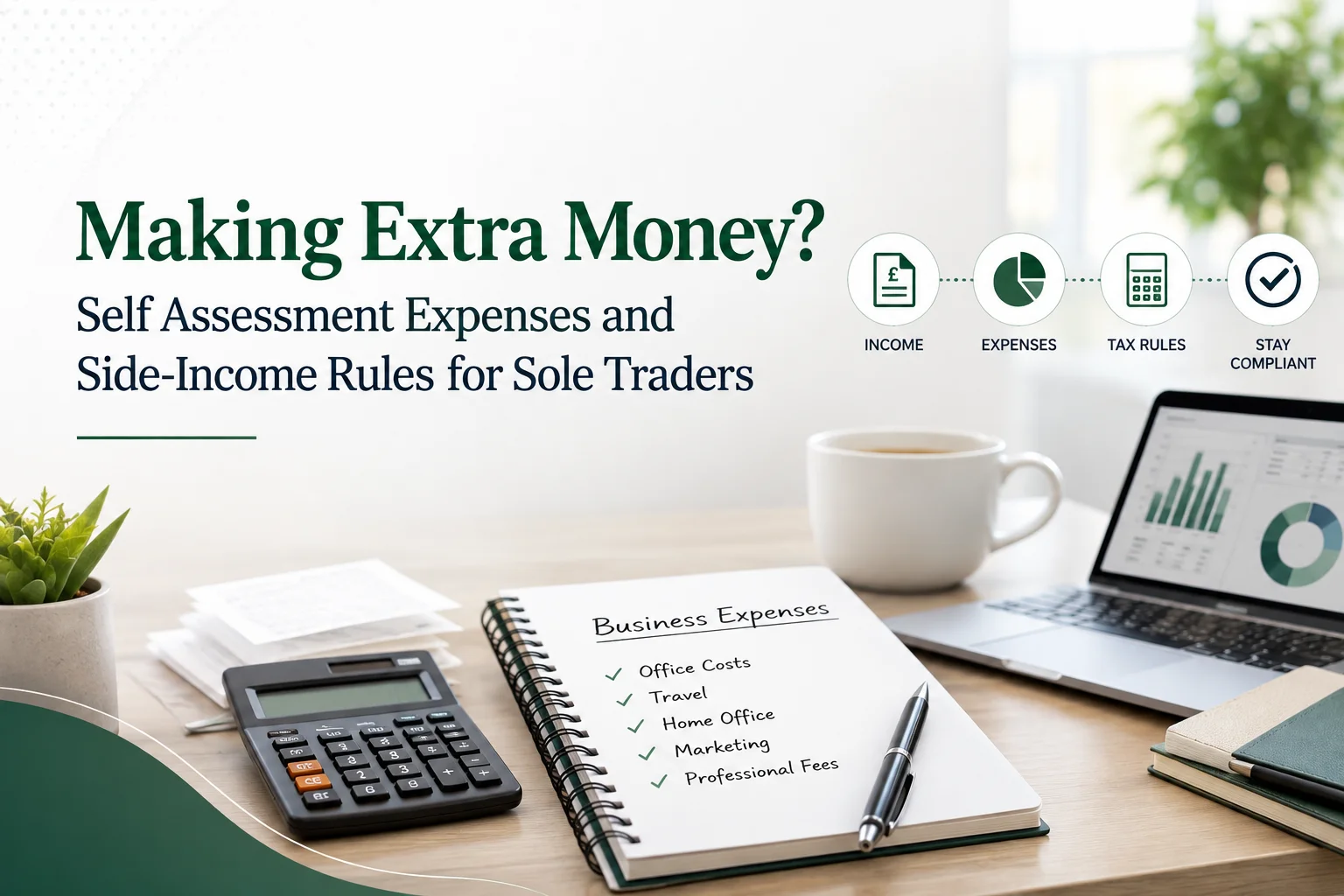
A weekend freelance project, online side business or extra job can increase your income, but it can also make your tax position less straightforward. Two questions usually follow: Do I need to tell HMRC about this extra income? And if I am self-employed, which business expenses can I claim?
For sole traders, qualifying business costs can normally be deducted when calculating taxable profit. Separately, the £1,000 trading allowance can simplify matters for some people with relatively small amounts of trading or casual income.
However, you generally cannot use the trading allowance and deduct actual business expenses against the same income. This guide explains Self Assessment allowable expenses, the trading allowance and how Self Assessment can apply when you have side income or a second job.
What Are Self Assessment Allowable Expenses?
If you are self-employed as a sole trader, your business will usually have costs involved in earning its income. HMRC calls qualifying costs allowable expenses.
These expenses can be deducted from business income when calculating taxable profit. For example, HMRC explains that if a sole trader has turnover of £40,000 and £10,000 of allowable expenses, the taxable profit before other relevant adjustments is £30,000. Personal withdrawals from the business are not allowable expenses.
This distinction matters: Business income − allowable business expenses = taxable business profit, subject to the applicable tax rules. It does not mean every payment from a business bank account is automatically deductible.
What Expenses Can a Sole Trader Claim?
HMRC identifies several common categories of allowable business expenses.
Office and Business Administration Costs
Business-related office expenses can include items such as:
- Stationery
- Printing
- Postage
- Business telephone costs
- Internet costs
- Certain software costs
If something is used for both personal and business purposes, only the business element can normally be claimed. HMRC gives the example of a £200 mobile-phone bill where £70 relates to business calls: only the £70 business portion is deductible.
Allowable travel costs can include relevant business expenditure such as:
- Fuel
- Parking
- Train and bus fares
- Taxi fares
- Vehicle insurance
- Repairs and servicing
- Hotel accommodation for qualifying business trips
However, HMRC does not allow deductions for private travel, fines or ordinary travel between home and a regular place of work. Simplified mileage expenses may also be available in certain circumstances.
Where you operate from business premises, allowable costs may include qualifying:
- Rent
- Business rates
- Heating
- Lighting
- Insurance
If you work from home, you may be able to claim a reasonable business proportion of costs such as electricity, heating, internet, telephone use, rent or mortgage interest. Simplified expenses can also be used for certain home-working costs.
Staff and Subcontractor Costs
HMRC allows qualifying staff costs including:
- Employee salaries
- Bonuses
- Employer pension contributions
- Employer National Insurance
- Agency fees
- Subcontractor costs
- Business-related staff training
Domestic help such as a nanny or carer is not treated as a business staff expense merely because you work while using that service.
If your business sells products, qualifying costs can include items bought specifically for resale and raw materials used to make goods. This can be particularly relevant to sole traders running ecommerce, craft, retail or product-based businesses.
Marketing and Advertising
Business advertising and marketing expenses can generally include qualifying costs such as website expenditure and other promotional activity. The key point remains that the expense must relate to the business rather than personal activity.
Professional and Financial Costs
Some professional costs can be allowable, including qualifying:
- Accountancy fees
- Legal fees
- Professional indemnity insurance
- Business bank charges
- Credit-card charges
- Interest on business borrowing
There is an important exception: HMRC specifically states that the cost of preparing and submitting your Self Assessment tax return itself is not an allowable business expense.
Training can qualify where it improves or updates skills and knowledge used in your existing business, including relevant new skills arising from changes in your industry. Training intended to help you start a completely new business or move into an unrelated field is generally not deductible under these rules.
What About Costs Used for Both Business and Personal Purposes?
This is one of the most common areas of confusion. Suppose you pay for:
- A mobile phone
- Internet access
- A vehicle
- Home electricity
and use each for both personal and business purposes. You normally claim only the part attributable to the business. HMRC requires a reasonable method for separating business and private costs. Keeping clear records throughout the year is therefore much safer than trying to estimate the business portion several months later when preparing the tax return.
The £1,000 Trading Allowance: Expenses or Allowance?
The trading allowance is a tax exemption of up to £1,000 per tax year for qualifying trading or certain miscellaneous income. It can cover income from areas such as:
- Self-employment
- Casual services such as gardening or babysitting
- Hiring out personal equipment
Where total qualifying gross trading income is £1,000 or less, you may not need to tell HMRC, although there are exceptions.
If Your Trading Income Is More Than £1,000
If qualifying gross income exceeds £1,000, you may be able to choose between:
Option 1: Claim actual allowable expenses or Option 2: Deduct the trading allowance instead
You cannot normally claim the £1,000 trading allowance and actual allowable expenses against the same qualifying income. For example, suppose your side business earns £5,000. If your qualifying actual expenses are £1,700, using actual expenses would leave £3,300 before other relevant tax adjustments.
If you instead use the £1,000 trading allowance, the corresponding amount would be £4,000. The appropriate method depends on your actual records and circumstances. Where genuine allowable expenses exceed £1,000, it is therefore important to compare the available methods rather than automatically using the allowance.
There are also circumstances where the trading allowance cannot be used, including certain income received from an employer, a connected company or partnership.
Do You Need Self Assessment for Side Income?
Having a side income does not automatically mean that you have a Self Assessment obligation. The answer depends on what type of income it is and how much you receive. HMRC specifically provides an online service for checking additional income from activities such as:
- Casual jobs
- Food delivery
- Gardening or babysitting
- Selling goods
- Renting property
- Hiring out equipment
- Creating online or social-media content
Self-Employed Side Income Above £1,000
If you are a sole trader and your gross trading income is more than £1,000 before expenses, you normally need to register for Self Assessment and declare the income. The important word is gross. For example:
- Side-hustle income: £2,800
- Business expenses: £1,200
- Profit before other adjustments: £1,600
The registration test is not based only on the £1,600 profit. Gross trading income was £2,800, which exceeds the £1,000 threshold.
What If Your Side Income Is £1,000 or Less?
Where qualifying gross trading income is £1,000 or less, you may not have to tell HMRC because of the trading allowance. However, HMRC identifies situations where a person may still need or choose to register, including where they want to claim a trading loss, pay voluntary Class 2 National Insurance contributions or support certain benefit claims.
The allowance is also unavailable for some categories of income. So the £1,000 figure should not be treated as a universal rule that makes every form of side income automatically tax-free.
What If You Have a Second Job as an Employee?
A second PAYE job is different from running a self-employed side business. If both roles are employment, your employers normally deduct Income Tax through PAYE. You have only one Personal Allowance for the tax year, even if you have multiple jobs and each employment will usually have its own tax code.
For example, HMRC explains that where the Personal Allowance is already being used against the main job, income from another employment may be taxed through a code such as BR, D0 or D1 depending on the person’s overall circumstances and applicable tax rates. Scottish and Welsh taxpayers can have different codes and rates.
Having two PAYE jobs does not by itself mean that you need to complete Self Assessment. But you could still need a return for another reason, such as separate self-employed income, property income, foreign income or another Self Assessment condition.
What If You Have a Job and a Self-Employed Side Hustle?
This is a very common situation. HMRC treats PAYE employment income and self-employed income separately when calculating how tax is collected. Your main employment may already use all or most of your Personal Allowance, while tax on qualifying self-employed profits may need to be dealt with through Self Assessment.
HMRC’s current guidance states that if your total employed income exceeds your Personal Allowance and your self-employed gross income is more than £1,000, you may need to pay tax on that self-employed income through Self Assessment.
Your actual tax liability depends on your total taxable income and circumstances, so you should not simply apply the tax rate from your main job to your side-business turnover.
When Do You Need to Register?
For side income earned during the 2025/26 tax year, which ended on 5 April 2026, a person who needs to submit Self Assessment for the first time should normally tell HMRC by 5 October 2026.
The standard deadline for filing the 2025/26 return online is 31 January 2027 and tax due must normally also be paid by that date. If you have only recently realised that you need to register, it is better to deal with the position promptly rather than waiting until January.
Records to Keep for Side Income and Expenses
If you earn additional income, keep enough information to show clearly:
- How much income you received
- When it was received
- Business expenses you paid
- Which expenses had both personal and business use
- Invoices and receipts
- Relevant bank transactions
- Platform or marketplace statements where applicable
HMRC requires taxpayers to keep records that support figures reported through Self Assessment. A practical approach is to separate business transactions from personal spending as early as possible. This makes it much easier to identify allowable expenses and prepare the return accurately.
Common Mistakes With Side Income and Sole-Trader Expenses
Several errors repeatedly create confusion:
Treating every purchase as an allowable expense
A cost must satisfy the relevant rules. Personal spending cannot simply be converted into a business expense because it was paid from a business account.
Claiming the trading allowance and actual expenses together
For the same qualifying trading income, you generally choose the trading allowance or actual expenses rather than claiming both.
Looking at profit instead of gross income for the £1,000 registration test
The relevant figure for the trading-income threshold is gross income before expenses.
Assuming a second job and a side hustle are taxed the same way
PAYE employment and self-employment are different. An employer normally deducts tax from employment income, whereas qualifying self-employed side income may need to be reported through Self Assessment.
Assuming HMRC already knows everything
Your employer reports PAYE earnings, but separate freelance, platform or casual income may still need action from you. HMRC provides a specific tool for checking whether additional income needs to be reported.
How SHRM Tax Advisors Can Support Sole Traders and People With Side Income
Side income can start simply and become more complicated as earnings grow, especially when you already have a salary, several sources of income or significant business expenses.
SHRM Tax Advisors’ Personal Tax Planning service can support individuals who need help understanding their Self Assessment position and organising the information required for their tax return. Professional advice can be particularly useful when you are unsure:
- Whether you need to register
- Whether the trading allowance applies
- Which expenses are allowable
- How to separate business and personal expenditure
- How employment and self-employment interact
- How to report multiple income sources correctly
Final Thoughts
If you are a sole trader, Self Assessment allowable expenses can reduce the business profit on which tax is calculated, but only qualifying business costs should be claimed.
For smaller side businesses, the £1,000 trading allowance can offer a simpler alternative to deducting actual expenses. If your qualifying gross trading income exceeds £1,000, you will normally need to consider Self Assessment registration and reporting requirements.
A second PAYE job is different: tax is normally dealt with through your employers and tax codes, although other income can still create a Self Assessment obligation.
The safest approach is to keep accurate records from the beginning and check the rules based on your actual income sources rather than assuming that all extra income is treated in the same way.
For professional support with Self Assessment and personal tax matters, contact SHRM Tax Advisors to discuss your circumstances.
This article provides general information only and does not constitute personalised tax advice. Individual tax treatment depends on your circumstances and applicable UK tax rules. Information checked against current HMRC and GOV.UK guidance on 7 August 2026.