Starting a business, earning money from a side activity or receiving income outside your salary can create a question that many new taxpayers ask:
Do I need to register for Self Assessment?
The answer depends on the type of income you received, how much you earned and whether HM Revenue and Customs can collect the correct tax without a tax return.
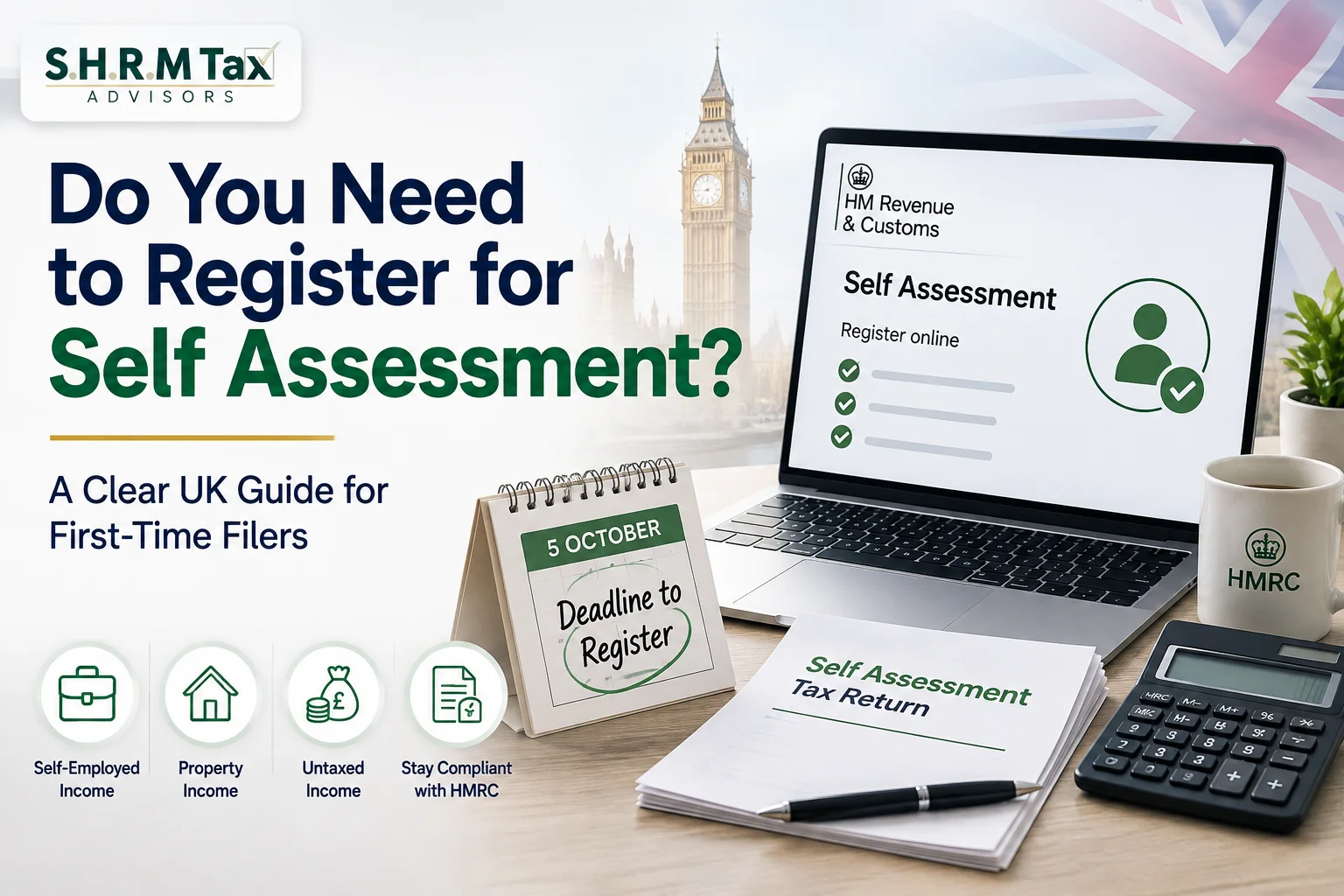
For the 2025/26 tax year, which ran from 6 April 2025 to 5 April 2026, new taxpayers who need to complete a return should normally tell HMRC by 5 October 2026. You do this by registering for Self Assessment.
This guide explains who normally needs to register, who may not need to and what to do if your circumstances are not straightforward.
What Does Registering for Self Assessment Mean?
Self Assessment is HMRC’s system for collecting tax from people whose income cannot be dealt with fully through PAYE or another automatic method.
Registering tells HMRC that you may need to complete a tax return. Once registration is processed, HMRC normally issues a Unique Taxpayer Reference, usually called a UTR. You need this reference to manage and submit your Self Assessment return. Registration and filing are two separate steps:
- You register or reactivate your Self Assessment account.
- You prepare and submit the tax return by the relevant filing deadline.
For a 2025/26 online tax return, the standard filing deadline is 31 January 2027. Any Self Assessment tax due is also normally payable by that date.
Who Must Register for Self Assessment?
You should first establish whether you need to send a tax return. HMRC identifies several common situations in which a return is required.
1. You Became Self-Employed as a Sole Trader
You normally need to register for Self Assessment as a sole trader if your gross trading income was more than £1,000 during the tax year. Gross income means the total amount received before deducting business expenses, allowances or tax reliefs. It is your turnover rather than your profit.
For example, imagine you earned £4,000 from freelance work and spent £2,500 on business costs. Your profit may be £1,500, but your gross trading income was £4,000. You would normally need to register because the gross income exceeded £1,000. This can apply to income from activities such as:
- Freelance and consultancy work
- Online selling carried out as a trade
- Content creation
- Tutoring or coaching
- Gardening, cleaning or repair work
- Design, marketing or technology services
- Hiring out personal equipment
- Other paid side activities
Not every person who sells an unwanted personal item is automatically trading. The nature, frequency and purpose of the activity matter. HMRC provides a dedicated checker for people who are uncertain whether additional income needs to be reported.
What If Your Trading Income Was £1,000 or Less?
If your annual gross trading income was £1,000 or less, the trading allowance may mean that you do not need to tell HMRC. However, there are situations in which you may still need or choose to register. These include when you:
- Want to claim relief for a trading loss
- Want to pay voluntary Class 2 National Insurance contributions
- Need to support a Tax-Free Childcare claim
- Need to support a Maternity Allowance claim
- Cannot use the trading allowance because of the source of the income
The trading allowance does not apply in every situation, including certain income received from an employer, partnership or connected company. You should therefore not assume that income below £1,000 is automatically outside Self Assessment.
2. You Became a Partner in a Business Partnership
If you were a partner in a business partnership, you normally need to register as a partner for Self Assessment. The partnership must also be registered separately. A nominated partner is responsible for registering the partnership and managing its partnership return obligations. Individual partners report their share of partnership income through their own tax returns.
This requirement is different from operating as a limited company. A limited company has separate Corporation Tax and company-filing obligations, although its directors may also need Self Assessment for personal reasons.
3. You Received Income From Renting Out Property
Property income is another common reason people enter Self Assessment. The property allowance may cover up to £1,000 of qualifying gross property income. Where annual gross property income is £1,000 or less, you may not have to report it, although exceptions can apply.
If the income is higher, you may need to tell HMRC or register for Self Assessment depending on the amount and circumstances. Examples of potentially reportable property income include:
- Renting out a residential property
- Income from a buy-to-let property
- Letting commercial property
- Renting out land
- Receiving a share of jointly owned rental income
- Some income from short-term accommodation
Different rules may apply to the Rent a Room Scheme, jointly owned property and non-resident landlords. Because property reporting depends on both gross income and taxable profit, landlords should check their exact position rather than relying only on a general threshold.
4. You Received Other Untaxed Income
You may need to register for Self Assessment when you have income on which the correct tax has not already been collected. HMRC lists common examples such as:
- Tips and commission
- Savings income
- Investment income
- Dividend income
- Foreign income
- Income from renting out property
Whether registration is required depends on the amount, the available allowances and whether HMRC can collect the tax through your PAYE code.
For example, an employee can still need Self Assessment if they receive substantial income outside their salary. Being taxed through PAYE does not automatically remove the need to report other taxable income.
5. You Had Capital Gains Tax to Pay
You must normally send a tax return if you had Capital Gains Tax to pay after selling or otherwise disposing of an asset that increased in value. Potential examples include disposals of:
- Shares and investments
- A second property
- Business assets
- Valuable personal possessions
- Cryptocurrency or other chargeable assets
Capital Gains Tax reporting can involve separate deadlines and reporting routes, particularly for certain UK property disposals. A person should therefore check the reporting requirements when the disposal occurs rather than waiting until the following January.
6. You Need to Pay the High Income Child Benefit Charge
You may need a tax return if you are responsible for paying the High Income Child Benefit Charge and the charge is not being collected through PAYE. HMRC now allows some taxpayers to deal with the charge through their PAYE tax code, so Self Assessment is not necessarily required in every case. The correct route depends on your circumstances and the way HMRC is collecting the charge.
7. You Are an Off-Payroll Worker Repaying a Student Loan
HMRC also identifies off-payroll workers who are repaying a student or postgraduate loan as a category that may need to submit a Self Assessment return. Off-payroll arrangements can be difficult to assess because tax may already have been deducted from some payments while additional reporting is still required.
8. You Received Foreign Income
UK residents normally pay UK tax on income from the UK and abroad, subject to the relevant residence rules, exemptions and reliefs. Foreign income may therefore create a Self Assessment obligation. Examples can include:
- Overseas employment or freelance income
- Foreign rental income
- Overseas pensions
- Interest from foreign bank accounts
- Dividends from overseas companies
- Gains from foreign assets
There are exceptions, and your UK residence status can materially affect the treatment. People with foreign income should avoid assuming that tax paid overseas removes the UK reporting requirement. SHRM’s International Tax Advisory service may be more appropriate where the position involves residence, double taxation or income from several countries.
Can You Register Voluntarily?
You can sometimes choose to complete a Self Assessment return even when you are not otherwise required to file. HMRC states that a person may choose to file to:
- Claim certain Income Tax reliefs
- Prove that they are self-employed
- Support a Tax-Free Childcare or Maternity Allowance claim
- Pay voluntary National Insurance contributions
Voluntary registration should still have a clear purpose. Entering Self Assessment can create ongoing filing obligations until HMRC confirms that returns are no longer required.
Do You Need to Register Again Every Year?
Usually, no. If you are already registered and continue submitting annual returns, you would not normally register again each year.
However, if you were registered previously but did not need to send a return for the 2024/25 tax year, you may need to reactivate your Self Assessment account for 2025/26. Filing without reactivating an existing account can delay the return. HMRC’s registration service directs users to the correct route based on whether they are:
- A sole trader
- A partner
- Registering for another reason
- Reactivating an earlier account
What If HMRC Has Already Asked You to File?
If HMRC has issued a notice requiring a tax return, do not simply ignore it because you believe you no longer meet the normal criteria. You should contact HMRC and ask it to review whether the return is still required. HMRC advises taxpayers to tell it as soon as possible if they believe they no longer need to file. Until HMRC confirms the position, failing to submit the requested return may lead to penalties.
What Is the Registration Deadline?
For income received during the 2025/26 tax year, first-time filers who need a return should normally register by: 5 October 2026 The same date generally applies when an earlier Self Assessment account needs to be reactivated.
If you register after 5 October, HMRC states that you could receive a penalty. A late-registration or failure-to-notify penalty can arise particularly where tax remains unpaid after the payment deadline. Missing 5 October does not mean that you should wait until the following year. Register as soon as you realise that a return may be required.
How to Register for Self Assessment
The safest starting point is HMRC’s online registration service. The process is generally:
- Check whether you need to send a tax return.
- Select the registration route that matches your circumstances.
- Provide the requested personal and income information.
- Wait for HMRC to process the registration.
- Obtain your UTR and online-account access.
- Gather the records needed for the return.
- Submit the return by the filing deadline.
HMRC advises first checking whether a return is required before registering. If you have registered before, the same service will tell you whether your account needs to be reactivated. Registration can take time, particularly when a UTR or online-access details must be issued. Leaving the process until late January can make an already unfamiliar task unnecessarily stressful.
Common Registration Mistakes
First-time taxpayers commonly create problems by:
- Looking at profit instead of gross trading income
- Assuming PAYE covers every source of income
- Forgetting property or overseas income
- Registering under the wrong category
- Creating a second account instead of reactivating an existing one
- Waiting until the filing deadline to register
- Assuming that HMRC automatically knows about a new business
- Ignoring a notice to file
- Believing that no tax due means no return is required
The registration decision should be based on your full circumstances, not one income figure considered in isolation.
How SHRM Tax Advisors Can Help
It is not always obvious whether you need to register for Self Assessment. The position can become more complicated when you have employment income alongside a business, jointly owned property, foreign income or an earlier Self Assessment record. Through its Personal Tax Planning service, SHRM Tax Advisors can help you:
- Review whether Self Assessment applies
- Identify the correct registration route
- Organise the information needed for your return
- Review self-employment, property and other untaxed income
- Prepare and submit an accurate tax return
- Understand the amount due and relevant deadlines
- Address related international or HMRC matters
Getting the position checked early can prevent rushed decisions close to the filing deadline.
Final Thoughts
You will commonly need to register for Self Assessment if you became a sole trader with gross trading income above £1,000, joined a business partnership or received income or gains that HMRC cannot tax automatically. However, Self Assessment is not determined by employment status alone. An employee, landlord, investor or person with foreign income may also need to file.
For the 2025/26 tax year, the main registration date to remember is 5 October 2026. Where you are uncertain, use HMRC’s official checker or obtain professional advice based on your complete tax position.
Speak with SHRM Tax Advisors for professional support with Self Assessment registration, tax-return preparation and personal tax planning.
This article provides general information and does not constitute personalised tax advice. Tax treatment depends on individual circumstances. Information reviewed on 5 August 2026.